In the winter semester of 2006/07, four fellow students and I advised a display distributor on digital signage as part of a project. Digital signage refers to the use of digital media content in advertising and information systems such as electronic posters, electronic traffic signs, in-store advertising, digital door signs or large-format projections. The resulting market analysis even predicted the trend towards 3D monitors at the time. The complete market analysis can be downloaded at the end of this article.
Around four years ago, digital signage was already highly successful in the USA. Huge projection surfaces had become almost impossible to imagine many cities without, and Las Vegas was regarded as the mecca of digital signage. In Europe, by contrast, the market was and remained relatively small. At the time, most people encountered digital signage only at airport information terminals or in fast-food restaurants. The client had displays that were ideally suited to this market but was entering a new field outside its traditional core business.
Market Forecast and Market-Entry Solutions
Under the supervision of Professor Dr Hartmut Federle, our project group analysed the existing market. As part of the market study, we compared various display manufacturers and providers of digital-signage solutions. We also analysed possible applications, collected experience reports on existing digital-signage systems and examined a new 3D technology. Finally, we developed a medium-term market forecast and solutions for entering the market.
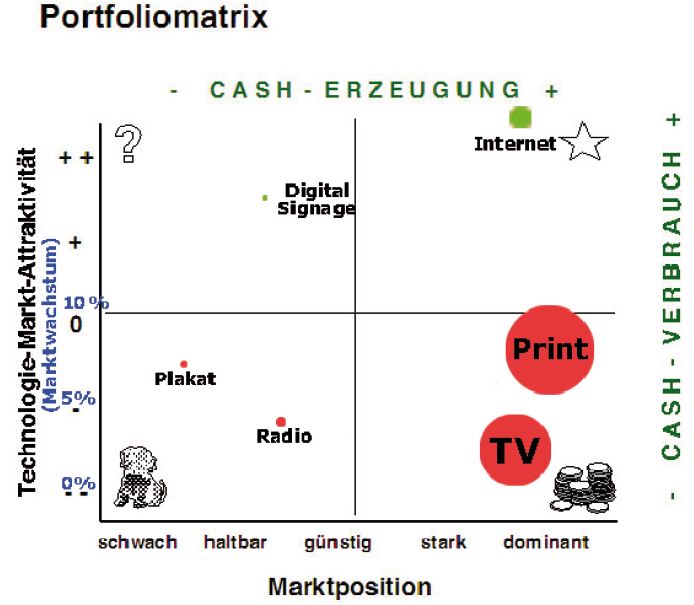
The project was very well received not only by the client but also by the supervising professor, who awarded it a grade of 1.3. I was certainly not entirely uninvolved in that result. From my time as managing director of an IT systems house, I already had solid knowledge of IT systems, distribution and project management. I also played a leading role in the documentation available for download here and in the excellent final presentation, even though I was not the project manager.
Forecast Better Than Most Analysts
Because the project involved a five-year market forecast and roughly that amount of time has now passed, this is a good opportunity to review how accurate our assumptions about the development of the digital-signage market in Europe (EMEA) were. In the summary on page 31, I made the following assumption:
“Digital signage will generate around one billion euros in the advertising market over the next five years. Part of this revenue will be taken from today’s poster advertising.”
Admittedly, many analysts expected more from the European digital-signage market at the time. This also came up as a question from the audience during the final presentation. I replied that those analysts were looking only at rising markets. In my view, it was unlikely that markets would develop positively every single year. In hindsight, that was a rather wise decision.
If you search today for figures on the development of the digital-signage market, you can still find one of those overly optimistic forecasts at berlin.business-on.de:
“In the study ‘Digital Signage in Europe – The opportunities for digital out-of-home advertising’, Goldmedia and Screen Digest forecast that net advertising revenue from digital out-of-home advertising would almost triple between 2008 and 2012 – from around €220 million in 2008 to more than €630 million in 2012.”
Current figures were published at the Munich Digital Signage Conference on 19 and 20 October 2010:
“Overall economic trends clearly point to strong growth in the German digital-signage market. Forecasts are at 20% and more, significantly above the targeted 14% growth. Demand supports this – investment will follow in 2011. Beyond Germany’s borders, however, things look less rosy: Spain and Portugal are on the floor, Italy and France are struggling, the UK is progressing only slowly, and Benelux and Scandinavia are sending mixed signals.”
So my forecast for Europe was apparently better than that of most analysts, although I believe that after the very severe financial crisis even my forecast ultimately proved too high.