
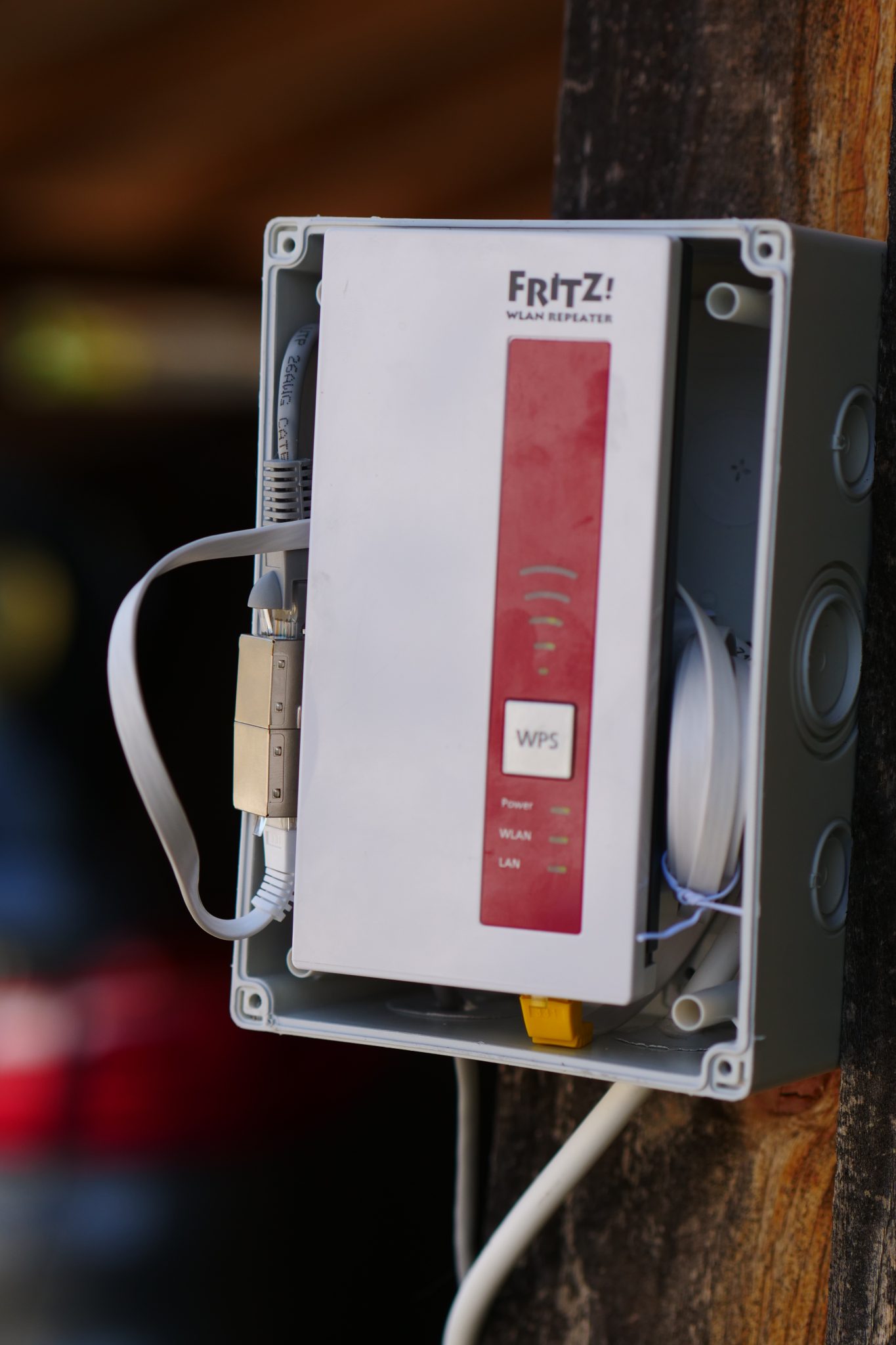
An outdoor Wi-Fi mesh system cost around €250 at the time (example: Netgear Orbi RBS50Y Outdoor Satellite). I thought it could be done much more cheaply, so I simply put a Fritz!WLAN Repeater into an IP65 enclosure.
The DIY outdoor Wi-Fi access point proved itself over several years in rain, snow and outdoor temperatures down to minus 20 degrees Celsius. This post documents the build and the experience from several years of continuous operation, and puts into context what has changed since.
Long-term experience and cost
Apart from occasional hard resets – I can remember two or three – the setup ran without problems. At the time of this report that was almost four years of continuous outdoor operation (as of January 2023). Neither rain, snow, cold nor heat caused any problems for the repeater inside the enclosure.
In addition to the IP65 enclosure, I bought a surface-mounted socket, an RJ45 coupler, a Schuko plug and a power cable. Total cost including the Fritz!WLAN Repeater 1750E: less than €100. A LAN cable is also needed if you do not want to, or cannot, connect the repeater to the mesh via Wi-Fi.
Build, safety and context
The effort involved is manageable – but wiring the socket requires experience with electrical work. If you do not have that, you should bring in an electrician. The enclosure protects the electronics, but it does not replace a proper installation: mains voltage, clean cable feedthroughs and condensation inside a sealed enclosure are all things to keep in mind if you build this yourself.
Update 2026
This post was written in 2019 and the build dates from 2018. At the time, a ready-made outdoor mesh system cost around €250 – that was the motivation for building it myself.
The documented long-term record for this build runs up to January 2023. Since then the market has changed: the FRITZ!WLAN Repeater 1750E is now an older model – AVM has discontinued personal support for it, and the last FRITZ!OS is version 7.32 from 19 March 2024.
Since October 2025, AVM has offered its own weatherproof repeater for the first time, the FRITZ!Repeater 1610 Outdoor: IP54, Wi-Fi 6, PoE+, €129.99 (RRP €149).
That makes the original cost argument outdated. For existing hardware, a build like this can still be an option, provided the device, enclosure and installation are suitable for it.
The following image gallery documents the build step by step.









Hallo Michael! Das ist eine super Idee. Fritz gibt aber eine Betriebstemperatur von 0 – 40°C an. Hattest du Probleme mit Minus-Graden?
Danke für deine Antwort!
Hallo Matthias,
nein, keine Probleme deswegen.
Der Repeater läuft seit mehreren Jahren und hat auch schön Temperatur von -20 Grad überstanden.
Viele Grüße!
Der Repeater verbraucht Strom und erzeugt daher auch Wärme.
Wenn man ihn in ein geschlossenes Gehäuse einbaut, glaube ich nicht, dass im Winter die Temperatur im Repeater unterhalb der zulässigen Betriebstemperatur sinkt. Vermutlich muss man jedoch im Sommer für eine Belüftung um einen Wärmestau zu vermeiden.
Danke Frank für Deine Ergänzung.
Das sehe ich auch so, dass durch die Abwärme Kälte nicht ganz so dramatisch ist.
Allerdings scheint der Repeater auch die Hitze gut weg zu stecken.
Die letzten Sommer waren bei uns hier im Süden jeweils von längeren Hitzeperioden geprägt.
Der Repeater bekommt im Tagesverlauf auch einiges an Sonnenstrahlung ab.
Auch das hat er bisher einige Jahre ohne Probleme mitgemacht.
Ich meine daher, wenn man den Repeater so platziert, dass er nicht permanent von der Sonne angestrahlt wird, dann packt die Konstruktion auch den Sommer.
Hallo .. postest du mal den Link zu dem “Gehäuse” (oder gerne auch per Mail). Muss sowas ähnliches hier auch mal versuchen.
Danke
Ich bin damals mit dem Repeater in einen OBI Markt und habe geschaut, dass ich ein Gehäuse finde, in das er mit der Steckdose passt.
Ich glaube das Gehäuse, dass ich dann gekauft habe war irgendein No-Name-Produkt.
Daher kann ich dir leider keinen Link posten. Sorry.
Hallo Michael,
wie ist denn die Dämpfung des Wlan Signals?
Ist das durch das Gehäuse spürbar?
Möchte das gleiche System mit einem Garagentoröffner machen den ich nach draussen legen will, weil in der Garage der Empfang nicht ausreicht.
Danke für kurze Rückmeldung.
Gruss Ralf
Hallo Ralf,
ich habe keine Probleme mit der Dämpfung.
Viel Erfolg bei deinem Projekt!