If you want to know how to get fast mobile internet while on holiday in Greece, you have come to the right place. For most travellers, mobile internet at their destination means the Wi-Fi at the hotel or a restaurant. Some holidaymakers may already have roaming packages with data allowances for other EU countries. However, these packages are usually limited to a few hundred MB and LTE roaming is only available in isolated cases. So if you want to use mobile internet at your holiday destination as you do at home, you need to get a local data SIM.
For my holiday in Greece, I bought an LTE-capable SIM card from the Greek market leader. Let’s see what Greek LTE can do. If you are planning something similar, pay particular attention to my conclusion at the end of the article. With a little luck, you may find an offer like I did on eBay. I found an LTE-capable SIM card through vasileios-gr on eBay. For €34 including shipping, “Cosmote Internet on the Go” gave me 7 GB to use over two weeks.
Of course, you can also buy a SIM card locally in a shop. Buying through eBay had significant advantages, however. I was able to get online immediately at the airport without any detours. The seller was also very helpful when the SIM card initially refused to register on the 4G network and resolved the issue with customer service. On top of that, he pointed me to a special Cosmote “Summer Offer”, which gave me another 1 GB free.
Warning: Disable Auto-Update!
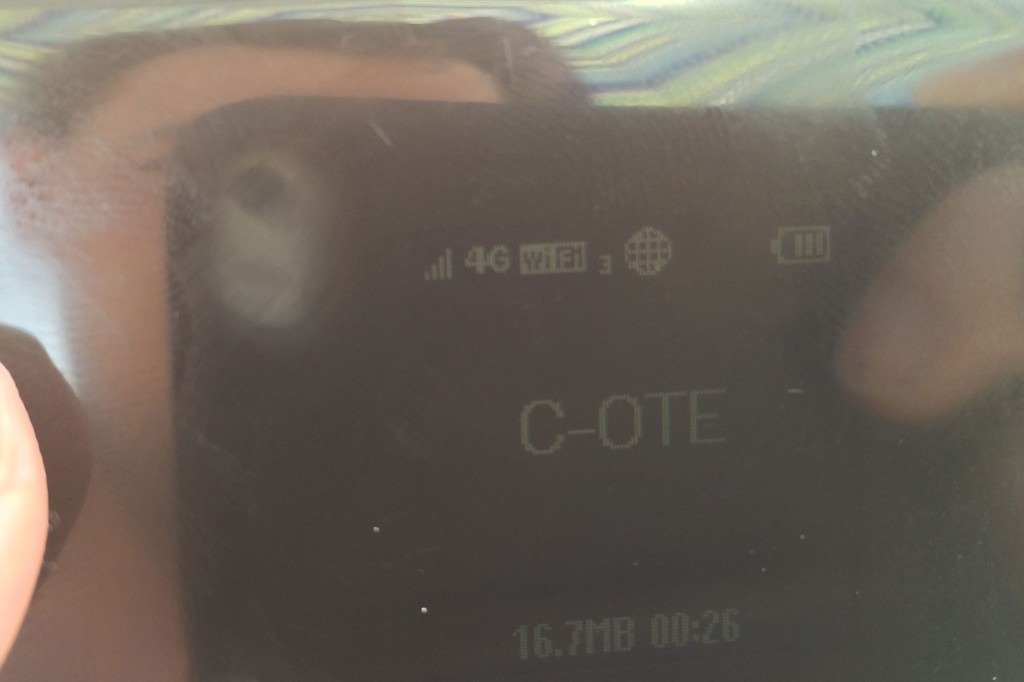
I used the SIM card in a Huawei E5667 mobile hotspot, providing internet access to smartphones, tablets and a Mac. Because our mobile devices thought they were connected to a normal Wi-Fi network and we had initially forgotten to disable automatic updates, we lost a few gigabytes that way.
I was surprised by the availability of LTE on the Greek islands of Santorini, Paros and Kos, as well as the almost constantly available 3G network on the ferries between the islands. However, having my own mobile hotspot was usually worthwhile only on Cosmote’s LTE network. As soon as you are on 3G, transfer rates drop significantly and the Wi-Fi networks in hotels and restaurants usually offer more speed.
Typical Speed Test on the 3G Network in Santorini
I was rarely able to measure more than 1 Mbit/s download speed on 3G; most of the time it was considerably less. You can clearly see that 3G networks, especially in holiday regions, have reached their capacity limits. The 3G network on the ferry was sometimes an exception.

Result on the 4G/LTE Network in Santorini
I measured values in this range at all my holiday destinations in Greece. The download rates, which are well below LTE’s maximum speeds, suggest that Cosmote’s LTE network was already quite heavily utilised.

4G at Athens Airport
But the Greeks can make LTE really fast too, as this speed test at Athens Airport demonstrates.

Wi-Fi/DSL Connection at a Hotel in Santorini
Finally, a comparison with the hotel Wi-Fi in Santorini. I was surprised by the 18 ms ping. Since I do not assume that the hotel itself is connected via DSL, the low latency is an indication to me that the island itself is already connected by fibre.

Conclusion
If you want to buy a local SIM card for internet access during your holiday in Greece, make absolutely sure that it supports 4G or LTE. Cosmote’s 3G network is hopelessly congested in the tourist areas. I assume the situation is not much different for the other operators, Vodafone and WIND.
Network operators should urgently enable LTE roaming for all contracts that support LTE in Germany. Foreign operators in particular should have an interest in this, as it relieves their 3G networks.